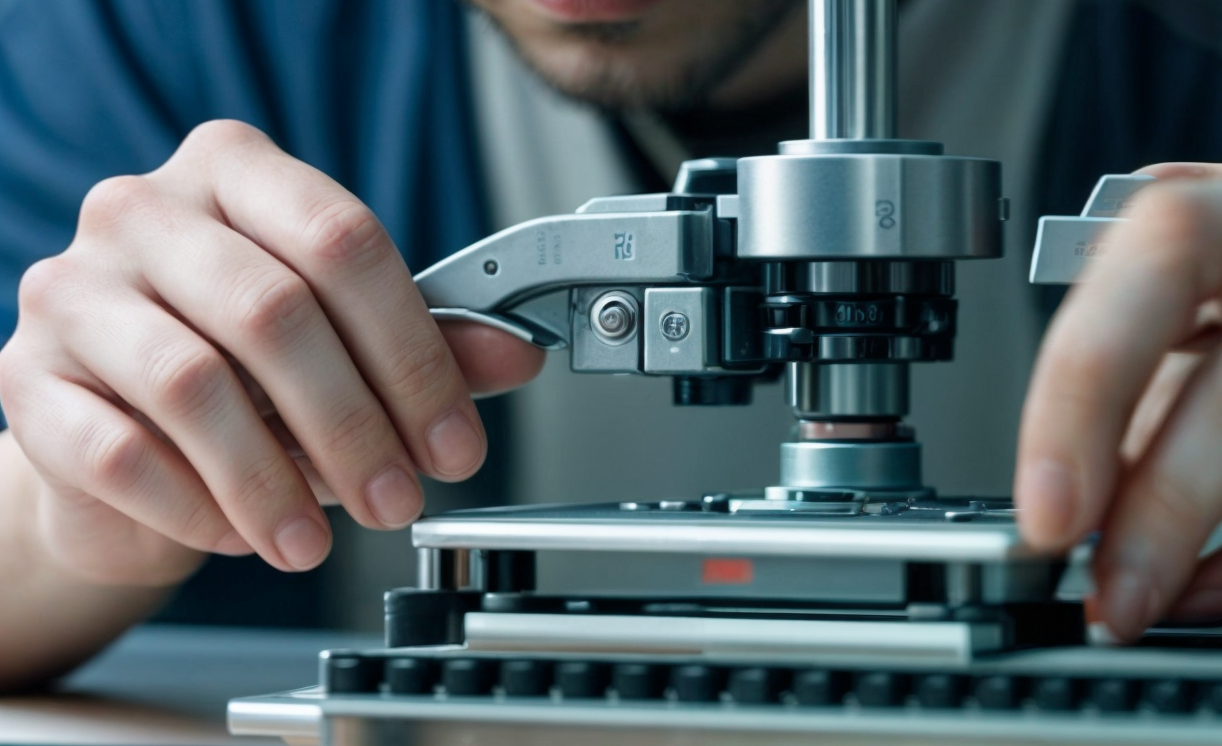
The Ugly Side of Product Design


Part 1 of our "Behind the Build" series
When people picture product design, especially in the medical and scientific world, they imagine the sleek, finished products The precision-engineered device in a clinician’s hand, the glossy render on a presentation slide, or the prototype that looks ready for manufacture.
But that’s not where design begins.
The real innovation often starts with something far less glamorous - exactly the kind of early exploration our New Product Science™ is designed to embrace.
At OPD, long before a device ever reaches its final form, there’s a stage that rarely makes it into client side presentations: the proof-of-principle phase. This is where we explore, test, and learn. It’s also where things can get, quite literally, ugly.
Walk into our workshop on any given day and you might find a prototype three times the size of its intended product. It’s a collection of off-the-shelf components mounted onto a test rig, held together with brackets, cables, and a lot of creative problem-solving.
There are breadboards with stacks of wires connecting boards and sensors. 3D-printed parts hastily modified to fit the latest tweak. Tangled setups that look more like they belong in a physics lab than a clean design studio.
And that’s exactly the point.
These “ugly” prototypes are where the important questions get answered - not about aesthetics, but about function. How a mechanism behaves. How a fluid moves. How a system performs under real-world conditions.
They allow our engineers to learn fast, fail safely, and true to our New Product Science prove that the science behind an idea really works before it ever reaches detailed design.

The early rig stage is all about momentum and understanding. By using adaptable, off-the-shelf elements, we can move quickly and explore multiple solutions before committing to custom design. It’s far easier to change a bracket or rewire a circuit at this stage than to redesign tooling later.
Each “ugly” build captures valuable learning, not just whether something works, but why it does, or doesn’t. It’s where we uncover the subtle dependencies between mechanical, electrical, thermal, and user-interaction factors that can make or break a device in production.
In many ways, this phase represents the true spirit of engineering creativity - and it’s a core pillar of our New Product Science™ . It’s where we experiment without fear of imperfection, where the fastest route to clarity is sometimes a cable-tied workaround or a hastily printed part.
Once we’ve proven the critical functions and gained the insights we need, that’s when refinement begins. The rigs shrink, the cables disappear, and the product starts to take shape.
At this point, we move from exploration to precision, from the “ugly” proof-of-principle to the refined, manufacturable system ready for verification and validation.
By the time the final product is revealed, the early prototypes are long gone, their components reused or retired. But the learning they delivered is embedded in every detail of the finished device.


In a world where polished outcomes dominate attention , the messy side of product design often goes unseen. Yet it’s essential. The ability to explore, test, and iterate quickly gives our clients confidence that the final product is built on solid technical foundations.
At OPD, we celebrate this stage. Because whether it’s a tangle of wires or a three-times-scale test rig, it represents progress: the critical bridge between idea and implementation.
So yes, the ugly side of product design exists. And it’s beautiful in its own way.

The finished product may get the spotlight, but it’s the unseen engineering work, the experimental rigs, the fast iterations, and the curiosity-driven experimentation, that makes real innovation possible.
At OPD, we take pride in embracing both sides: the beauty of the final product and the creative chaos that New Product Science™ harnesses to get us there.
Read Part 2, where we go deeper into the engineering and validation work that turns these rough rigs into reliable, compliant, and manufacturable devices.